En la Argentina la pobreza está infantilizada: en el segundo semestre de 2017, había 163 niños en situación de pobreza por cada 100 adultos en la misma situación. Además, este patrón muestra signos de agravarse: en 2003 la relación era 140 niños por cada 100 adultos.
La situación es alarmante por varios motivos. Si bien la pobreza bajó en los últimos años, los más afectados por la pobreza hoy son niños: incluso tras esta baja, en 2018 el 41% de los niños argentinos vive en la pobreza. Los niños y adolescentes son sujetos plenos de derechos y el Estado tiene la responsabilidad de garantizar sus derechos.
La inversión en infancia y adolescencia viene en aumento desde 1995 pero aún así no logró reducir la infantilización de la pobreza. Por este motivo, es imperativo revisar su efectividad, calidad y el impacto que tiene sobre el bienestar de niños, niñas y adolescentes.
La inversión en infancia y adolescencia entre 1995 y 2015
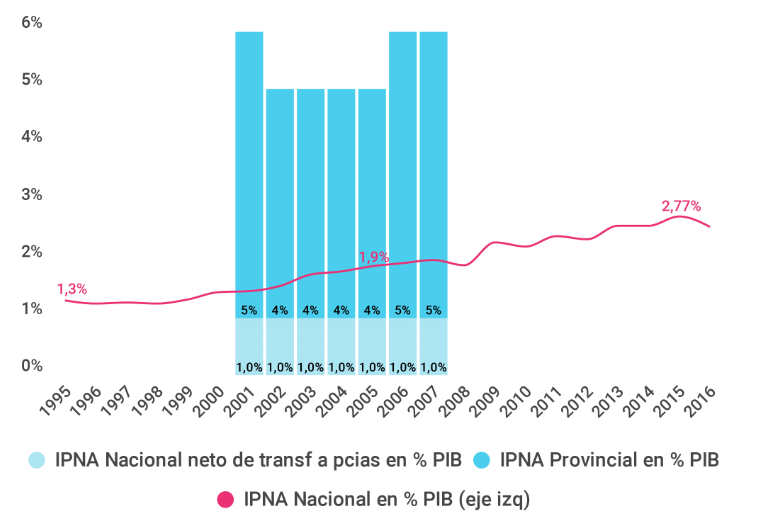
La inversión del Estado nacional dirigida a niños y adolescentes viene aumentando desde 1995, y duplicó su valor de 1,3 puntos porcentuales del PBI a 2,6 p.p. en 2016.
La inversión consolidada –que incluye también los esfuerzos realizados por las provincias-, varió entre los 5 y los 6 puntos del PBI entre 2001 y 2007, y promedió 5,4% en ese período. El esfuerzo realizado por las provincias y la Ciudad de Buenos Aires explica 4,4 puntos de este promedio.
Inversión Pública en Niñez y Adolescencia en porcentajes del PBI. Argentina (1995-2016)
La tendencia general de la inversión entre 1995 y 2016 es de alza. La inversión social en niñez y adolescencia pasó de representar alrededor de un 12% del presupuesto social a fines de la década de 1990 a un 16% entre 2008 y 2016. El período de mayor expansión en términos relativos fue el que siguió a la crisis social, económica y política de 2001: el promedio entre 2002 y 2008 fue de 17,3% del presupuesto social.
Inversión Pública Nacional en niñez y adolescencia como porcentajes del PBI, del Gasto Público Total y del Gasto Público Social (1995-2016)
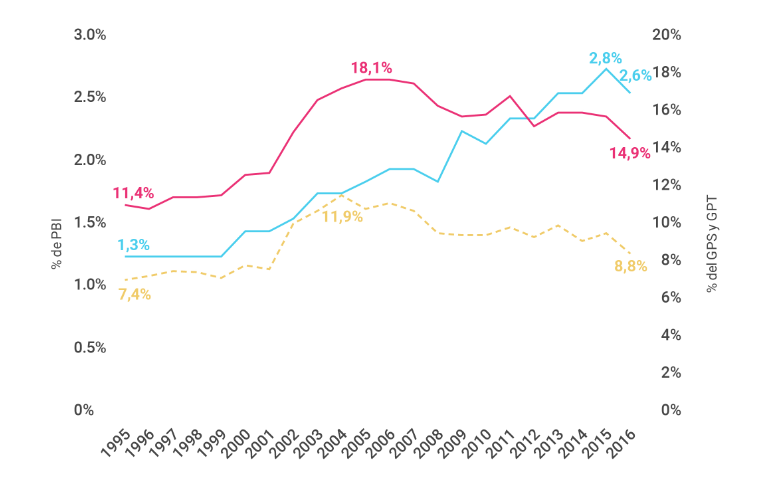
Fuente: CIPPEC (2018) sobre la base de Dirección Nacional de Política Fiscal y de Ingresos del Ministerio de Hacienda de la Nación
Sin embargo, en los años de devaluación y contracción económica (2012, 2014 y 2016) la inversión dirigida a la infancia y adolescencia cayó. Esto es particularmente relevante en el contexto actual de la Argentina: ante mayor incertidumbre y volatilidad macroeconómica, los indicadores de pobreza e indigencia comienzan a aumentar. En el primer semestre de 2018, la proporción de personas viviendo por debajo de la línea de pobreza era de un 27,3%, lo que representa un aumento de 1,6 puntos porcentuales respecto del semestre anterior.
El vínculo entre recesión y reducción de la inversión prioritaria en niños y adolescentes no es una relación de necesidad: durante la crisis global que se desató en 2008, algunos países lograron disminuir la pobreza infantil y proteger especialmente a los grupos vulnerables de los peores efectos recesivos (UNICEF Innocenti Project, 2014).
El efecto de las crisis sobre el bienestar de la infancia y la adolescencia depende no solo de la profundidad de la crisis, sino sobre todo de las condiciones políticas previas y de la respuesta de política pública que lideren los gobiernos (UNICEF Innocenti Project, 2014). Por este mismo motivo es crucial comprometerse a sostener los niveles de inversión para proteger los derechos de niños y adolescentes y asegurar el camino del desarrollo sustentable.
Cambios en la tendencia: el escenario a partir de 2016
Entre 2015 y 2016, la variación de la inversión pública en niñez y adolescencia en pesos corrientes fue de 28,9%. Sin embargo, cuando se ajusta por inflación, hubo una caída de 7,4% en términos reales. Esto marca un cambio en la tendencia anterior.
Actualmente no están disponibles los datos consolidados para hacer un análisis comparativo de los años 2017 y 2018 (aún en ejecución). Para analizar este período, se eligieron un conjunto de iniciativas por su alto impacto en el bienestar de niños y adolescentes. A partir ellos se ve que en los años 2017 y 2018, la inversión real en áreas críticas del bienestar infantil y adolescente cayó.
Crédito vigente y ejecución en millones de pesos de 2015. Programas seleccionados (2015-2018)
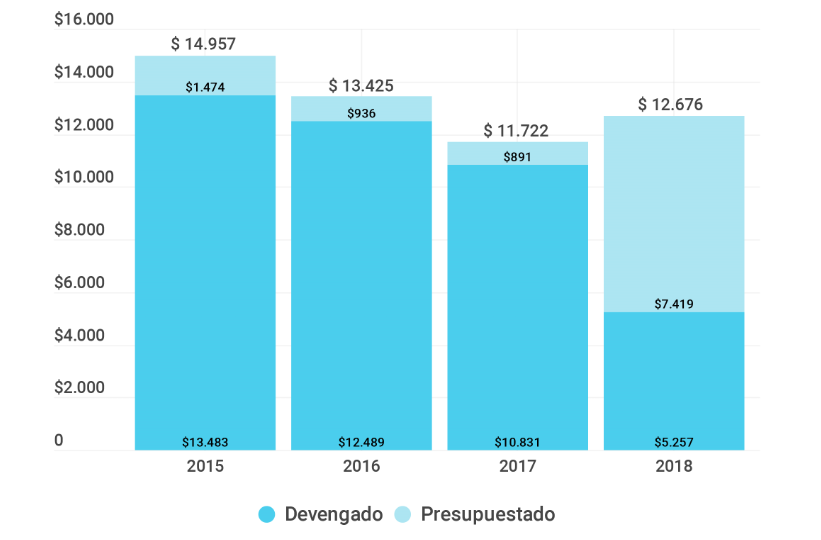
Fuente: CIPPEC (2018) en base a Presupuesto Abierto (www.presupuestoabierto.gob.ar). Incluye las modificaciones presupuestarias de la Decisión Administrativa 1605/2018
Los niveles de ejecución de los programas seleccionados para el análisis de este período varían notoriamente. Algunos programas se acercaron al 100% de ejecución, por ejemplo, los programas dependientes de gestión educativa y políticas socioeducativas del entonces Ministerio de Educación y Deportes (98,5%), y el Programa de Prevención y Control de Enfermedades Inmunoprevenibles (95%). El programa de Fortalecimiento Edilicio de Jardines Infantiles dependiente de Educación y las Acciones de Promoción y Protección Integral de los Derechos de Niñas, Niños y Adolescentes, de la Secretaría Nacional de Niñez, Adolescencia y Familia (SENNAF) del Ministerio de Desarrollo Social, alcanzaron el 81% y 91% de ejecución respectivamente.
Otros programas tuvieron resultados más magros. Promoción y Asistencia a los Espacios de Primera Infancia, que también depende de SENNAF, apenas superó el 75% de ejecución. El Programa de Sanidad Escolar, del Ministerio de Salud, ejecutó solo el 55% de su presupuesto en 2017.
El presupuesto 2018 también es heterogéneo en el grado de ampliación o ajuste de recursos otorgados a programas respecto de 2017.
El 10 de septiembre se publicó en el Boletín Oficial una serie de modificaciones presupuestarias que afectaron los créditos vigentes (presupuesto original y modificaciones presupuestarias) correspondientes a determinadas iniciativas relacionadas con la infancia de los Ministerios de Educación, Cultura, Ciencia y Tecnología y de la Secretaría de Niñez y Adolescencia.
Estas corresponden a un aumento presupuestario de $15 millones (0,4% de presupuesto adicional) del programa “Gestión Educativa y Políticas Socioeducativas” y una disminución de $3,35 millones (0,3% del presupuesto vigente del programa) y $117,87 millones (10% del presupuesto vigente) en los programas “Acciones para la Promoción y Protección Integral de los Derechos de Niños, Niñas y Adolescentes” y “Promoción y Asistencia a Espacios de Primera Infancia” de la SENNAF, respectivamente. Otro programa que sufrió disminuciones en su presupuesto, es el de “Políticas Federales para la Promoción de los Derechos de Niños y Adolescentes”, por un monto total de $2,8 millones.
La intención de invertir fuertemente en el desarrollo de espacios de primera infancia que se evidenciaba en el crédito inicial se postergó en función de las necesidades presupuestarias de otras áreas y por el alto grado de subejecución de las áreas responsables. Esto es particularmente preocupante en la medida en que al decrecimiento que se observa entre 2017 y 2018 de las partidas asignadas a estos programas se suma ahora una reasignación sustancial.
Los datos referidos al nivel de ejecución en 2018 generan incertidumbre sobre el uso efectivo de esos recursos para garantizar los derechos de los niños: solo las líneas de Asignaciones Familiares y las Acciones para la Promoción y Protección Integral de los Derechos de Niños, Niñas y Adolescentes tienen un nivel de ejecución mayor al 50%. Los programas destinados al fortalecimiento de espacios de crianza, enseñanza o cuidado infantil apenas superan el tercio de lo presupuestado.
Esta subejecución, ¿responde a problemas de gestión y planificación, obstáculos en la implementación o factores vinculados con déficits de planificación e implementación, articulación interjusrisdiccional o debilidades técnico-institucionales de determinadas áreas?
Entender esto es fundamental en tanto un período de crisis y recesión como el que atraviesa la Argentina actualmente pone en riesgo las garantías necesarias para el ejercicio de los derechos de los niños, niñas y adolescentes, especialmente en.
¿Cómo se puede fortalecer la inversión en infancia y adolescencia?
El financiamiento de las políticas dirigidas a la infancia y la adolescencia es crítico para hacer realidad sus derechos. Lograrlo exige revisar la efectividad, calidad y el impacto de la inversión del Estado dirigida a niños, niñas y adolescentes.
Tres recomendaciones para fortalecer la estructura de la inversión social en infancia y adolescencia consisten en:
1 – Asegurar los fondos presupuestarios destinados a los programas que tienen un impacto significativo y demostrado sobre el bienestar de los niños y adolescentes. La tendencia de la inversión social en niñez y adolescencia está fuertemente asociada al ciclo macroeconómico: se reduce durante los períodos de devaluación o contracción económica –como sucedió en 2012, 2014 y 2016-, lo que genera un impacto negativo sobre los niños y niñas y el bienestar de sus familias. Para contrarrestar esto, se debe respetar el principio de intangibilidad de los fondos y se debe asegurar que no haya una pérdida de valor real de los recursos presupuestarios asignados a la niñez y la adolescencia. Para lograr esto y sostenerlo en el mediano y largo plazo es fundamental incluir acuerdos entre las jurisdicciones y entre los ministerios.
2 – Monitorear y evaluar la calidad de la inversión, es decir, el impacto que los recursos utilizados tienen sobre el bienestar y los derechos de niñas, niños y adolescentes. El aumento de la inversión pública en niñez y adolescencia no trajo aparejada una mejora relativa de la situación de los niños y adolescentes por ende es crucial transparentar las transferencias que se realizan a estos grupos poblacionales de modo tal de poder evaluar la calidad de la inversión. Entre otros, es necesario desagregar las partidas presupuestarias por rangos etarios a fin de conocer qué inversión se hace en estas poblaciones, fortalecer el seguimiento de esta inversión, según su tipo y funcionalidad, tanto en el nivel nacional como entre los entes provinciales y recuperar la medición de la inversión consolidada en niñez y adolescencia que se discontinuó desde 2008.
3 – Mejorar y fortalecer los formatos institucionales -tales como el Gabinete de Desarrollo Humano y la figura del Defensor del Niño – involucrados en las distintas etapas del ciclo presupuestario para poder guiar los esfuerzos comunes orientados a cumplir los derechos de los niños y adolescentes.